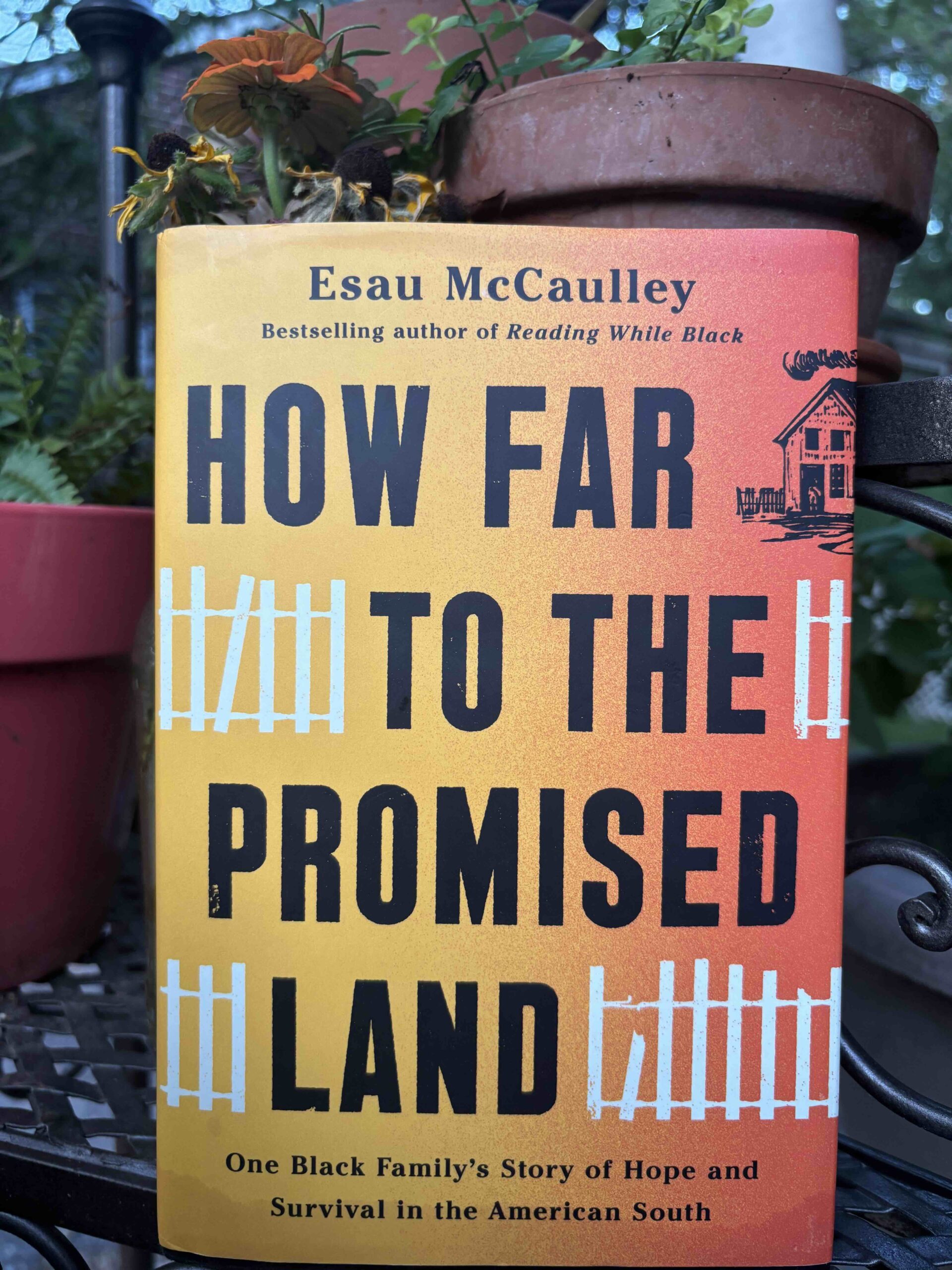
Reflections on How Far to the Promised Land
a story of hope and survival
I just finished reading How Far to the Promised Land, a memoir by Dr. Easu McCaulley. Here, Esau recounts his family history and his journey out of poverty in the deep American South. He names the harm of intergenerational trauma and racism, and how his family and Black Americans in the south struggled to escape cycles of violence, alcoholism, drug addictions, and poverty.
As a white woman in her mid 30’s reading his story, I came face to face with my own privilege. While my own childhood and adolescent years were marked by some deep struggle, I never had to worry about being pulled over by police because of my skin, my mother not having enough food to put on the table for us, my relatives getting caught up in violence and/or drugs, living in neighborhood with so much crime, my dad not coming home, and I didn’t experience the ongoing burden and stigma that can come with having black skin.
People of color experienced (and still experience) tremendous hardships in the south, and, as Esau recounts, they also demonstrate so much strength in the struggle.
I was deeply moved by this, and encouraged by Esau’s honest wrestling with his story.
For me, this was also a moving story of how Esau wrestled with very difficult family dynamics, particularly with his absent father, and how he chose to see the good in the hard. He found beauty in the ugly, naming not only his father’s absence and neglect, but also his father’s persistence, resilience, and redemptive journey. He was able to see his father as a product, in a way, of the environment he was in, the patterns his own family shaped, and the burdens placed on him as a black man.
When people hurt us, particularly those closest to us within our own family, it is a courageous and humbling thing to do to peel back the layers and try to make sense of the “why.” It is also noble to name the good and the beautiful.
People are complex
People are not merely good or bad, we are all a mix of everything all at once. Our stories shape us in ways that produce both goodness and beauty, and darkness and ugly. I believe this is one way we can honor those who have come before us, those within our own family, to name the hurt while naming the good. The baggage we carry didn’t start with us, and it probably didn’t start with our parents either.
Pain goes way back.
But so does goodness, beauty, and strength.
Esau not only speaks about intergenerational trauma but also intergenerational resilience.
He names the beautiful things — qualities of sacrifice, persistence, creativity, resourcefulness, dedication, service, faith, among others — that were passed down his family line. He names his process of embracing the good, while both grieving and forgiving the harm.
trusting the slow and steady work of God
I was so grateful for how Esau made space for the complexity of a person. How we are all messy people caught up in our own stories of struggle and strength. One of my favorite lines in his story is this:
“I still do not know how to make sense of the combination of kindness and callousness in the same person. But, in truth, the possibility of goodness in those who do evil is not different in principle from the capability of good people to fail us. Things we separate intellectually into neat categories are messy in real life. My neighborhood, then, could be both dangerous and wonderful at the same time. That is why the idea of grace and forgiveness is so important to me. If we are all a mix of good and bad, then there is always a chance that the good might emerge victorious in the end, if we give God enough time to do his work. Patience with broken people and broken things is a manifestation of trust in God.” p. 176
Thank you, Esau, for telling your story.
Thank you for naming the hurt and the beauty.
Thank you for naming the power of the slow and steady work of God.


You May Also Like
Insomnia: Turning My Worst Enemy Into My Greatest Teacher

Freckles: a story of rescue & redemption